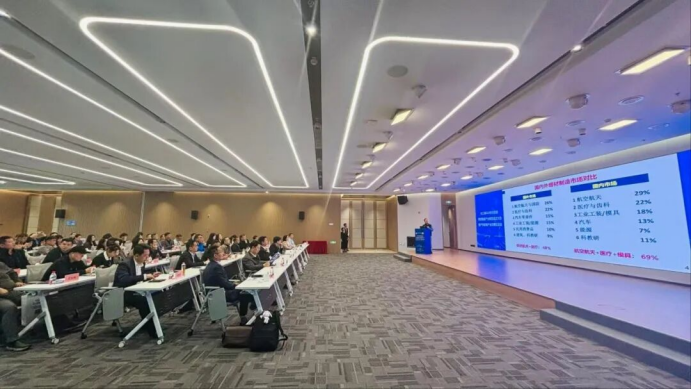
The founding meeting of the Yangtze River Delta G60 Science and Technology Innovation Corridor Additive Manufacturing Industry Alliance, together with an industry–university–research–application matchmaking event, took place in Shanghai’s Songjiang district on 3 November.
In his address, Chen Chao, deputy director of the G60 joint office, said that the corridor was in its tenth year of development and had been positioned as a strategic transmission axis for innovation. He described additive manufacturing as an important means of developing new productive capabilities. The nine G60 cities have complementary industrial strengths, and Songjiang would act as an originating centre and hub, supporting the alliance’s operations. He called the initiative a practical step towards collaboration between industrial platforms. He urged the alliance to establish joint research mechanisms in which companies define problems and partners develop solutions together, bring research outcomes into use, make supply-and-demand matching a regular activity, and connect research results with industrial applications. He also called for transferable experience in cross-regional cooperation and a replicable operating mechanism that could support collaboration in other G60 industries.
Academician Li Lin, the alliance’s first chair, delivered an address and keynote presentation setting out its development direction and priorities, including coordinated innovation across the nine cities and closer integration between industry, universities and research organisations.
The alliance was formally inaugurated in the presence of participating representatives, and its first chair, vice-chair and council organisations received their appointments. The event marked the start of an operational structure for cross-regional additive-manufacturing cooperation among the nine cities. Aviation expert Academician Liu Daxiang was appointed honorary chair. Chen Changjun, a professor at Soochow University and secretary-general of the G60 corridor alliance, was appointed secretary-general of the additive-manufacturing alliance. Specialists from universities and research institutes then joined upstream and downstream companies for presentations and round-table discussions on priority areas including aerospace and the low-altitude economy, building agreement on industrial cooperation.
The meeting established a platform for pooling additive-manufacturing resources and complementary strengths across the nine cities. It is intended to connect innovation, industrial activity, finance and talent, support technical development and commercialisation, and improve matching between the supply of and demand for production resources. The stated aim is a more complete additive-manufacturing ecosystem that supports advanced manufacturing in the Yangtze River Delta.