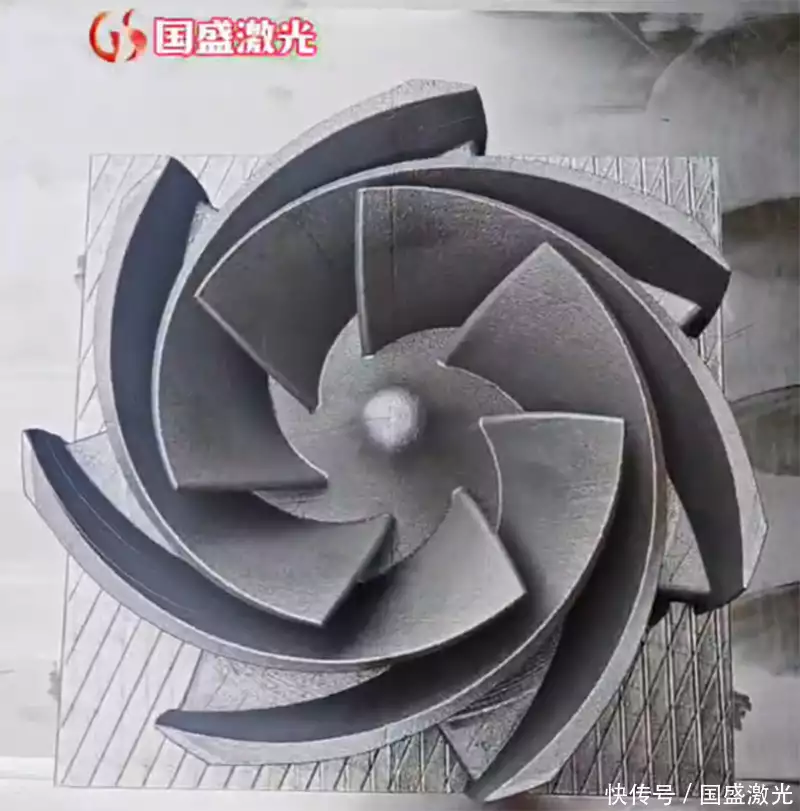
Titanium-alloy impellers are important components in aeroengines, gas turbines and other advanced equipment, and their manufacturing processes affect performance and reliability. Developments in laser additive manufacturing allow complex structures to be built with shorter production cycles and less material waste, offering additional routes to lighter, higher-performance components.
Titanium combines a strong strength-to-weight ratio, corrosion resistance and high-temperature capability, but conventional production presents difficulties. Forging requires costly dies and large equipment and limits internal geometry; casting can suffer porosity and shrinkage; machining has low material utilisation and substantial tool wear. Layer-by-layer laser melting of powder provides an alternative, with opportunities to control microstructure and mechanical properties and produce designs that are difficult to manufacture conventionally.
Two principal approaches are selective laser melting (SLM) and laser metal deposition (LMD). SLM scans fine titanium-alloy powder according to a 3D model in an inert atmosphere, producing dense parts. The application discussion reports densities up to 99.9% and mechanical properties approaching or exceeding those of forgings. LMD feeds powder directly into a laser melt pool and is useful for building or repairing larger impellers. SLM favours detailed, complex geometry, while LMD offers advantages for larger components and repair.
Process optimisation is central to quality. Laser power, scan speed, layer thickness and scanning strategy affect the result. Suitable preheating and interlayer cooling can reduce residual stress, distortion and cracking. Post-processing may include hot isostatic pressing (HIP), machining and surface finishing to meet dimensional and surface requirements. Research attributed to the Chinese Academy of Sciences’ Institute of Metal Research reports improved fatigue behaviour through parameter optimisation and a service-life increase exceeding 30% relative to the conventional comparison process.
The discussion describes aerospace use of laser-printed titanium impellers, including an unnamed compressor-impeller example with a reported 15% weight reduction and 20% increase in strength. It also identifies gas-turbine impellers designed for higher temperatures and improved generation efficiency. Design customisation and rapid iteration allow engineers to explore flow passages and cooling channels beyond conventional manufacturing constraints.
Challenges include the cost of high-purity powder and specialised equipment, the need for online monitoring and quality standards, and distortion control in large impellers. Support structures and process strategies require further development. Industry specialists expect improvements in materials, equipment and process experience to support wider industrial deployment over the following three to five years.
Laser-printed titanium impellers are part of the shift towards digital and intelligent advanced manufacturing. Chinese research institutes and companies have developed capabilities spanning materials, equipment and process engineering. Academician Wang Huaming’s team at Beihang University achieved significant results in large titanium structures, with its laser rapid-forming technology receiving a first prize in China’s State Technological Invention Awards. Developing standards also support more consistent industrial application.
Future development directions include multi-material printing, intelligent process control and larger build sizes. AI and data analysis may support real-time optimisation and defect prediction, improving consistency and reliability. Better material utilisation and potential energy savings can also contribute to more resource-efficient equipment manufacturing.
Laser additive manufacturing broadens the options for titanium impeller production, addressing constraints in established processes and enabling new designs. Continued technical development and production experience can strengthen advanced-equipment manufacturing and the supply of critical components, while extending the technology to additional applications.