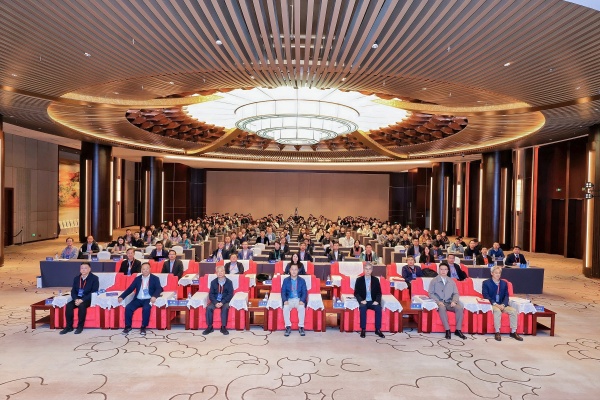
The eighth Symposium on Advanced Laser Manufacturing Technology Applications took place at the Holiday Inn Changchun Jingyue from 30 October to 1 November 2026 under the theme “Extreme Intelligent Manufacturing: Light Opens the Future”. The event was organised by the Chinese Mechanical Engineering Society and hosted by its Non-traditional Machining Institution, Changchun University of Science and Technology, and the Ministry of Education Key Laboratory of Cross-scale Micro and Nano Manufacturing. Co-organisers included Beijing University of Technology, Zhejiang University of Technology, Shanghai Jiao Tong University, Beijing Institute of Technology, Jiangsu University, Laserfair and the journal Electromachining & Mould. More than 260 delegates from universities, research institutes and companies across China attended.
Professor Xu Jinkai, executive chair of the symposium and director of the Ministry of Education Key Laboratory of Cross-scale Micro and Nano Manufacturing at Changchun University of Science and Technology, chaired the opening ceremony. Wang Chao, a university vice president, and Wu Qiang, deputy director of the Chinese Mechanical Engineering Society’s Non-traditional Machining Institution, delivered opening addresses.
On the morning of 31 October, plenary presentations were delivered by Professor Mei Xuesong of Xi’an Jiaotong University, Professor Shi Yusheng of Huazhong University of Science and Technology, Professor Guo Bin of Harbin Institute of Technology, Professor Li Ming of Shandong University, researcher Tang Ye of the 25th Institute of the Second Academy of China Aerospace Science and Industry Corporation, and researcher Wu Bin of Shenyang Aircraft Design and Research Institute. Their respective topics were the current state and development of five-axis laser microprocessing scanning systems; metal multi-material additive manufacturing with controllable macro- and microscale shape and properties; progress in intelligent manufacturing combining lasers with other energy fields; laser manufacturing through adaptive optical-field control; development trends and manufacturing approaches for complex system structures; and additive manufacturing in aircraft structural development.
Seven parallel sessions were held on the afternoon of 31 October. Speakers included Professor Cui Jianlei of Xi’an Jiaotong University, researcher Qi Junfeng of Beijing Satellite Manufacturing Co., Ltd., Professor Zhang Qunli of Zhejiang University of Technology, Professor He Jiankang of Xi’an Jiaotong University, Professor Song Bo of Huazhong University of Science and Technology, Professor Yang Lijun of Harbin Institute of Technology, Professor Liao Zhirong of the University of Nottingham, and Professor Ma Zhichao of Jilin University. The programme covered methods and mechanisms for high-performance laser fabrication of carbon-based integrated-circuit transistors; size effects and practical applications in additively manufactured, extremely lightweight spacecraft structures; the meaning and development of space manufacturing; rapid laser nitriding of iron-based alloys and its mechanisms; 4D printing of micro/nanoelectronics and intelligent composite structures; advances in additively manufactured functional metastructures; mechanisms and quality control in combined optical–liquid processing of high-performance, difficult-to-machine materials; inverse-problem-based laser control for advanced materials processing; and in-situ-test-driven control of droplet bouncing on laser-generated biomimetic surfaces.
On 1 November, delegates took part in technical visits and research activities at Chang Guang Satellite Technology Co., Ltd. and the Changchun Xinguang Industrial Park. The visits examined how laser and optoelectronic technologies are being integrated into commercial aerospace and emerging industries.
The symposium series was established in 2009 by the Chinese Mechanical Engineering Society’s Non-traditional Machining Institution, the Chinese Optical Society’s committee on laser processing, and Beijing University of Technology, to provide a distinctive learning and exchange platform for researchers and engineers in laser processing. Hosting this edition demonstrated the academic coordination and research capabilities of Changchun University of Science and Technology’s cross-scale micro/nano manufacturing laboratory. The meeting presented recent Chinese research in advanced laser manufacturing, while the technical visits strengthened connections between industrial needs and research capabilities. Together, these activities support the deeper application of laser manufacturing to national strategic requirements and regional industrial development.