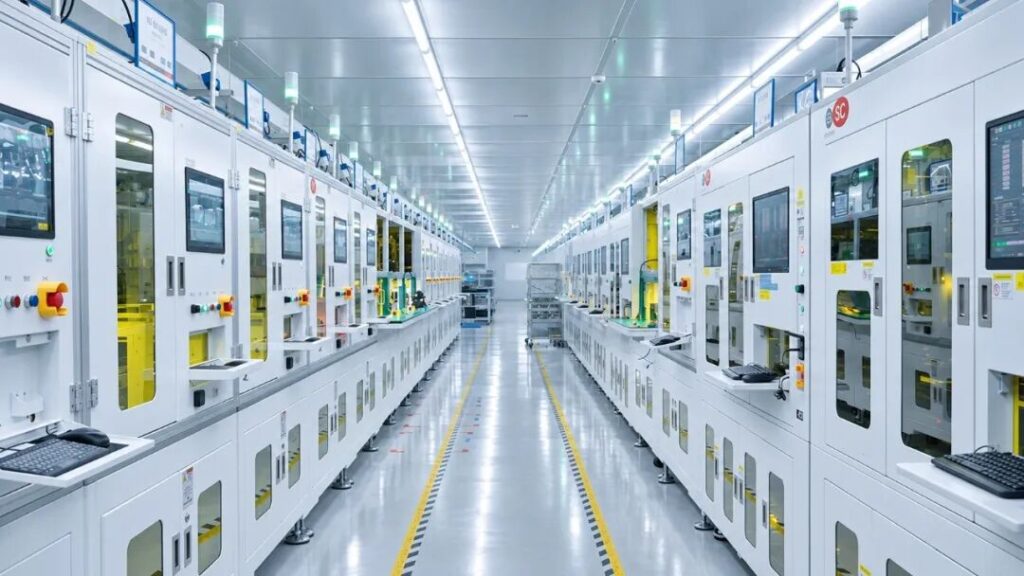
On 4 November, RoboSense officially brought a fully automated digital LiDAR production line into operation at Nanshan Zhizao’s Honghualing base in Shenzhen. The new line has an overall automation rate of 99% and a designed annual capacity of 500,000 units. It further integrates the company’s research, development and manufacturing operations, supporting continued digital-product development and volume deliveries.
The line contains more than 100 high-precision automated machines covering over 70 processes, connecting final assembly, calibration, testing and packaging. Only six operators are required to work alongside the systems in final assembly. A digital manufacturing management system provides full-process traceability for 100% of production data, while fully automated inspection covers 98% of production. RoboSense’s MARS intelligent manufacturing base currently has more than 22 automated lines, with a digital LiDAR unit coming off the lines every eight seconds on average.
During the first three quarters of 2026, RoboSense sold a cumulative 1.3148 million LiDAR units, including 427,800 units for robotics. Its products are used in intelligent vehicles, robotaxis, robotic lawnmowers, autonomous delivery and commercial cleaning.
The precision line is located in Nanshan Zhizao’s Honghualing base, described as China’s first demonstration project for multi-storey industrial manufacturing. Spiral vehicle ramps and multi-level elevated logistics platforms carry freight traffic to different floors. Trucks can reach the equipment entrance on the same floor as RoboSense’s production line, facilitating the movement of large production machines, materials and finished products. This gives high-rise factory buildings the logistics infrastructure needed for precision manufacturing and efficient dispatch.
The newly commissioned line is also part of RoboSense’s plan for annual capacity of four million units. Drawing on internally developed chips, a digital-product platform and scaled manufacturing, the company plans to improve delivery capabilities, expand its physical-AI and robotics core-component activities, and support the application of robotics technologies in a wider range of real-world settings.