Wavefront sensing is an important part of optical metrology, adaptive optics and alignment. Traditional methods such as Shack–Hartmann sensors and interferometers offer high performance but often require dedicated hardware, careful alignment and additional system complexity. Faster measurement requirements and a need for more flexible deployment are increasing interest in computational approaches.
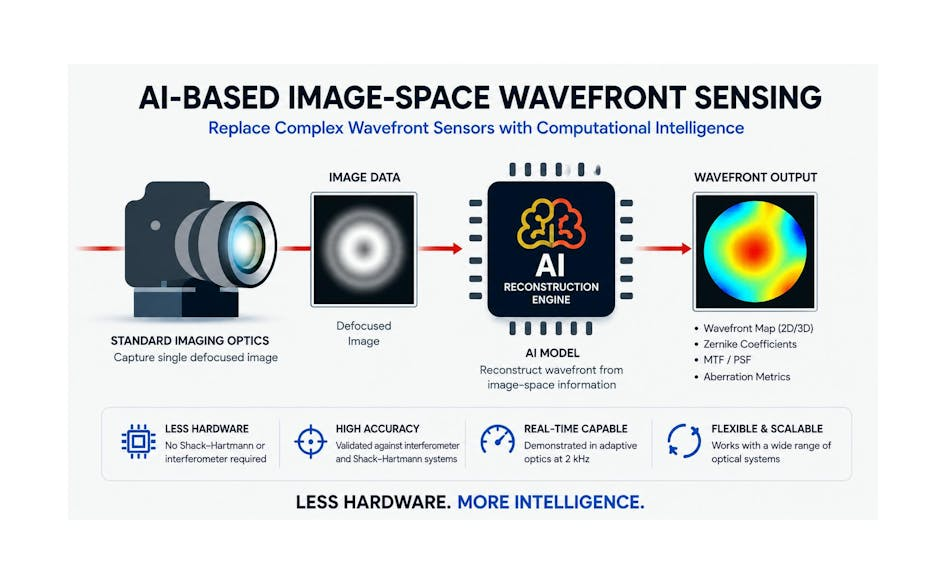
The Innovations Foresight team’s image-space method uses machine-learning reconstruction from a defocused image. The developers report accurate wavefront estimates using standard imaging hardware, reducing hardware complexity and supporting real-time operation. Instead of a dedicated wavefront-sensing assembly, their single-image method reconstructs the wavefront computationally from ordinary image data.
The method first captures a defocused image of the source illuminating the optic under test. A machine-learning reconstruction pipeline then estimates the wavefront from image-space information, producing Zernike coefficients, two- and three-dimensional wavefront maps, point-spread-function analysis, modulation-transfer-function estimates and optical-aberration metrics.
Because the method operates on image data, the developers describe integration into different optical arrangements without dedicated wavefront-sensing hardware.
Comparison with conventional methods
The team evaluated accuracy and repeatability against interferometric and Shack–Hartmann measurements [1].
The reported comparisons show agreement in major aberration terms, Zernike coefficients and overall wavefront structure. The computational method also produced stable and repeatable reconstruction under different optical conditions using standard imaging hardware.
Comparisons across several optical configurations and laboratory arrangements were reported to support its reconstruction performance and repeatability, with lower hardware complexity and less demanding alignment than conventional arrangements.
The team also describes several years of use by astronomers for telescope alignment and optical-performance evaluation under actual observing conditions, including variations in atmospheric seeing.
Additional proposed practical benefits include reduced hardware complexity, greater tolerance of vibration, high dynamic range, easier integration and full-field aberration analysis within one measurement.
Real-time adaptive optics
One demonstration operated an adaptive-optics system at rates up to 2 kHz [2–4]. In that implementation, the computational reconstruction engine ran within the control loop, estimating and correcting the wavefront in a changing optical environment.
The demonstration indicates that the approach can extend beyond static or offline metrology into real-time adaptive optics. Kilohertz-rate reconstruction using standard imaging hardware suggests applications in adaptive optics, astronomy and other high-speed optical-control systems.
Integration with metrology workflows
Innovations Foresight has incorporated the framework into its AI4Wave and SkyWave software platforms. Its reliance on image-space information rather than dedicated sensing hardware allows adaptation to different imaging and optical configurations.
Applications described include optical alignment, wavefront metrology, adaptive optics, optical testing, telescope assessment and autocollimator-based arrangements, in laboratories and the field. More generally, the method can be integrated where defocused images are available from the optical path under test, without major changes to the existing arrangement.
One example combines AI4Wave with Optical Perspectives Group’s Point Source Microscope, extending the instrument from alignment into wavefront metrology and optical-performance analysis [5].
Towards computational optical metrology
Computational reconstruction creates opportunities in metrology, adaptive optics and optical instrumentation. Moving some sensing functions from specialised hardware to image reconstruction can reduce complexity and improve deployment where dedicated hardware is difficult to integrate, sensitive to vibration, expensive or inconvenient [6].
Image-space sensing can extract wavefront information directly from defocused images using existing imaging hardware and standard optical configurations. This supports the development of compact, scalable systems suitable for research, industrial and astronomical use in the field.
As optical systems become faster, more integrated and more software-defined, computational image-space wavefront sensing is a promising direction for metrology and adaptive-optics instrumentation.
Research references
1. G. Baudat and J. B. Hayes, Proceedings of SPIE 11490, 114900U, 21 August 2020. DOI: 10.1117/12.2568018.
2. G. Baudat, D. Lavanchy and G. Müller, Proceedings of SPIE 13373, 133730G, 2025. DOI: 10.1117/12.3043339.
3. G. Baudat and colleagues, SPIE Astronomical Telescopes + Instrumentation, 6 July 2026.
4. Innovations Foresight, sub-millisecond AI4Wave wavefront-sensing demonstration, video.
5. Demonstration video associated with the Point Source Microscope integration described above.
6. G. Baudat and R. E. Parks, Optical Engineering 64(4), 044101, April 2025. DOI: 10.1117/1.OE.64.4.044101.