The industry challenge: supporting the next generation of displays
Founded in 1994, AP Systems established its semiconductor-equipment business through equipment-control software and integration expertise. Its activities include equipment for small- and medium-sized LCDs, 300 mm wafer processing and large LCDs. The company is a leading supplier in excimer laser annealing (ELA), laser lift-off (LLO) and OLED encapsulation, all important equipment areas in OLED panel production.
OLED manufacturers face pressure to lower costs, improve productivity and increase automation. Larger display formats add demands for stability, precision and continuous uptime. Coherent’s VYPER excimer systems provide strong performance but require periodic maintenance. “Increasing competition among display manufacturers has driven us to address the limitations of traditional ELA systems and explore advanced solutions,” said John Bae, AP Systems’ equipment sales head and senior vice president. “Our long relationship with Coherent allows us to draw on their laser and optics expertise to address these challenges.”
“Working with Coherent enables us to change OLED manufacturing. Together, we are addressing today’s challenges while shaping the future of advanced displays.”
John Bae, Equipment Sales Head and Senior Vice President, AP Systems.
The solution
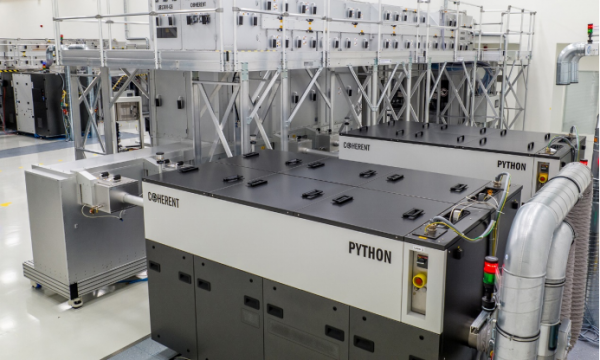
PYTHON lasers and the solid-state laser annealing (SLA) system target the cost of generation-8.6 OLED manufacturing by increasing productivity, uptime and automation. New equipment must integrate with existing processes: a new line in a dedicated facility can cost substantially more than upgrading an existing line. AP Systems therefore worked with Coherent to integrate the PYTHON laser into its next-generation G8.6 SLA system. Based on diode-pumped solid-state (DPSS) technology, PYTHON is described as offering longer service life, lower maintenance needs and higher stability than VYPER. The integration provides the following benefits.
Improved beam performance: greater stability reduces substrate defects such as non-uniformity, broadens the process window and supports display performance and service life.
System integration: an established, forward-looking design approach supports incorporation of PYTHON into AP Systems’ G8.6 display equipment.
Compatibility with future production: PYTHON retains the performance and form-factor requirements associated with VYPER and uses the same optical-system design as ELA. This supports comparable or better line-beam performance while retaining the established ELA process history, allowing SLA to pursue the same process quality in planned G8.6 capacity expansion.
From testing towards full production
The cooperation led to deployment of an SLA demonstration system that received positive feedback from major display manufacturers. It validated SLA performance and provided a basis for future factory investment. “Our SLA laser system has made a substantial difference,” Bae said. “Customers value the opportunity to evaluate the process directly, and the results establish new benchmarks for OLED display production.” Integrating PYTHON with the SLA system produced several practical benefits.
Lower costs: longer laser life and reduced maintenance support manufacturers’ production-cost targets.
Higher productivity: stable raw-beam performance supports processing efficiency and consistent output as demand for high-quality displays increases.
Future development: the scalable SLA design supports AP Systems’ adoption of technologies for advanced OLED production.
The next stage of cooperation
AP Systems and Coherent intend to build on the project and continue developing OLED manufacturing. PYTHON and SLA systems are expected to support changing requirements for larger screens, higher performance and improved user experience.
Bae concluded: “Working with Coherent enables us to change OLED manufacturing.”
“Together, we are addressing today’s challenges while shaping the future of high-end displays.” The customer application illustrates how Coherent’s laser technology and collaborative development can help equipment suppliers such as AP Systems improve OLED production performance and efficiency.