Development of back-contact cell technology
Photovoltaic-cell efficiency has physical limits. At room temperature, crystalline silicon’s optical bandgap restricts the photon energies it can use effectively, while photons with excess energy lose part of that energy. Considering these effects together, the cited room-temperature efficiency limit for a silicon single-junction cell is approximately 29.4%.
Passivation is central to improving cell efficiency. PERC, TOPCon and heterojunction, or HJT, cells use different passivation approaches. The comparison uses theoretical limiting efficiencies of 28.7% for bifacial TOPCon cells and 28.5% for HJT cells.
Back-contact, or BC, technology uses rear-side patterning to place the p+ emitter, n+ back-surface-field regions and metal grid on the back of the cell. This differs from technologies whose main efficiency and performance changes come from altering the passivation-layer structure.
BC is a platform approach compatible with other passivated-cell technologies. TBC combines the higher short-circuit current of BC with TOPCon’s passivating contacts. HBC combines BC’s higher short-circuit current with the higher open-circuit voltage of HJT.
In the production comparison, HPBC improves cell efficiency substantially relative to PERC, reaching 24.6% at factory acceptance, with a corresponding increase in equipment investment. The comparison gives TBC an efficiency advantage of about one percentage point over TOPCon, with a larger increase in equipment investment.
BC products combine efficiency with appearance. Removing the metal grid from the front improves module appearance, while higher efficiency can provide more electricity output for a comparable visual design.
Laser applications in BC processing
Expansion of BC capacity increases demand for laser equipment. Lasers account for part of equipment value in a PERC line of a given gigawatt capacity, and their share is higher in a BC line.
Lasers are used for layer opening, oxidation, etching, sintering and annealing in BC processing. Layer-opening methods can be matched to different cell substrates and film materials.
Laser processing offers non-contact operation, room-temperature preparation, simpler process flows, fast alignment and precision. Bottlenecks remain: when laser layer opening forms the rear-side BC pattern, the large number of rear grid features can make processing time and equipment cycle time longer, reducing throughput.
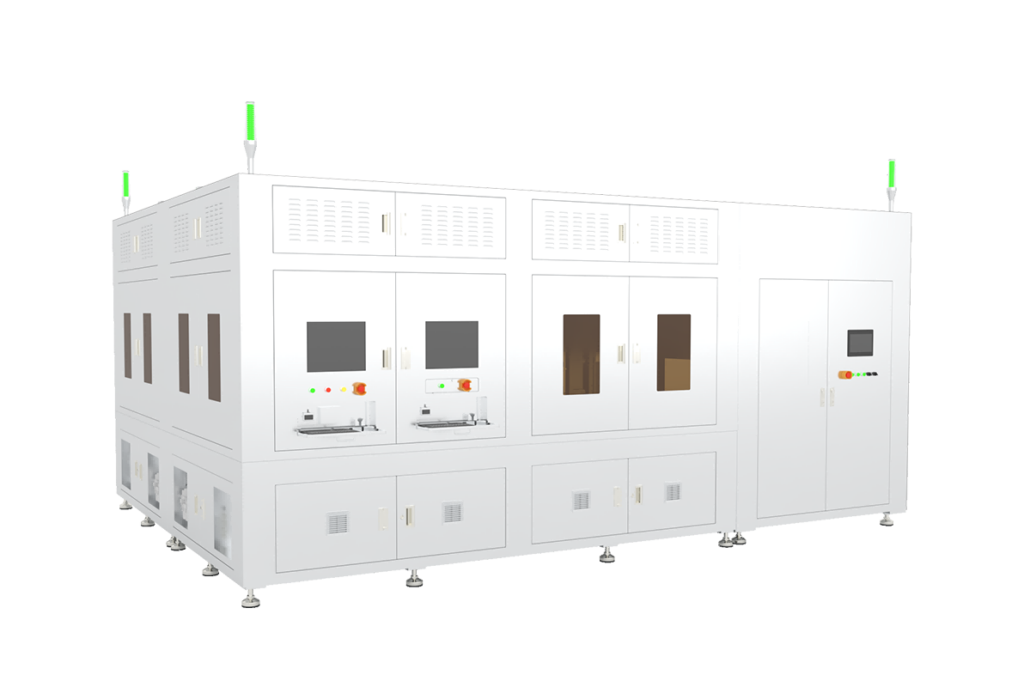
Volume-production BC laser equipment normally includes automated loading and unloading, vision recognition, laser optics and dust extraction. Major optical components include the laser, mirrors, beam expanders, diffractive optical elements, scanning galvanometers and field lenses.
Scanning galvanometers position the laser spot by moving motor-driven mirrors. Laser layer opening includes direct and indirect approaches and is fundamentally associated with changes in the film material.
As cell technology develops, equipment requirements increase, including demand for larger spots. Enlarging a shaped spot requires not only a different DOE but also sufficient energy to maintain the corresponding energy density, placing additional requirements on the laser source.
Lasers also contribute to TOPCon oxidation and thinning. Laser oxidation can form silicon oxide on the polysilicon layer to protect a selective TOPCon structure. Laser thinning adds a processing step that enables rear-side polysilicon patterning, with potential improvements in bifaciality and cell efficiency.