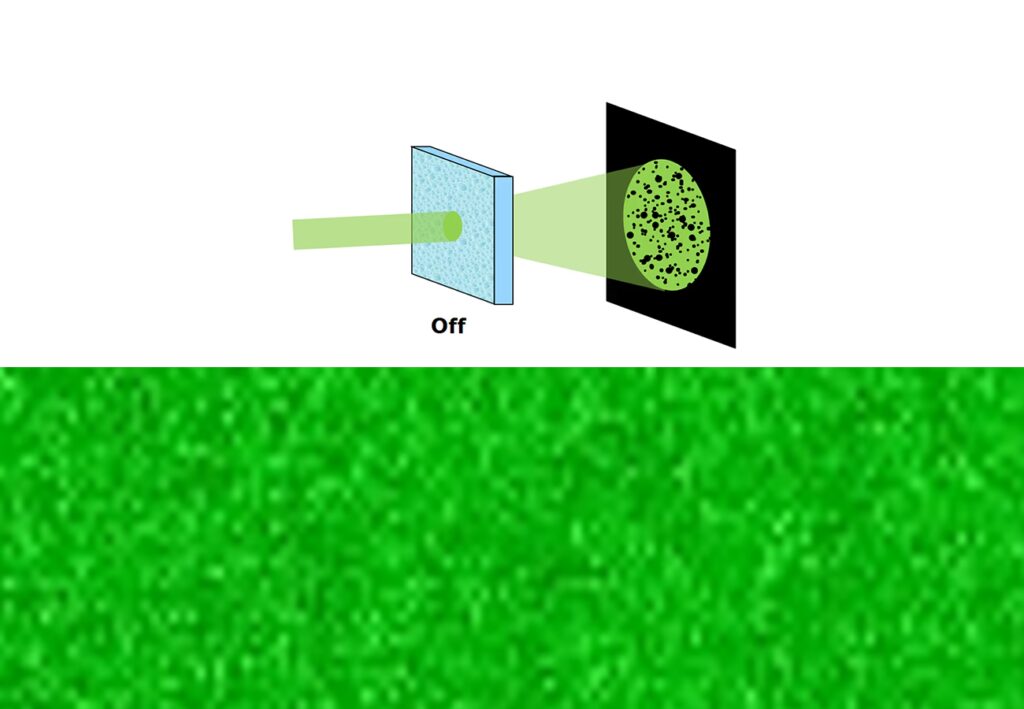
Summary: The grainy appearance of a laser image is speckle, a random interference pattern produced when coherent light illuminates a rough surface. Speckle contrast below roughly 4% is often difficult for the eye to detect. Two broad suppression approaches reduce temporal or spatial coherence, allowing multiple uncorrelated speckle patterns to average during the observation time.
Engineers working on laser-based augmented reality or projection will recognise the effect: a fine grain appears across the image, as though it were covered by a thin layer of sand.
This is speckle rather than pixel noise. Researchers observed such granular patterns when laser light illuminated surfaces soon after lasers were first developed.
It is a consequence of coherent illumination rather than necessarily a hardware fault. Understanding its origin is the starting point for selecting a suppression method.
The physics of speckle: random interference of coherent light
Speckle originates in random interference.
At a visible laser wavelength of roughly 0.5 µm, many everyday surfaces are optically rough: their height variations exceed the wavelength. When laser light reaches such a surface, its small features act as individual sources of scattered waves.
Because laser light is highly coherent, the scattered waves reaching the eye have sufficiently stable phase relationships to interfere. The distances from the scattering points to the eye differ, producing a random distribution of phase differences.
The superposition of many waves with different phases produces a random pattern of bright and dark regions. Constructive interference produces bright regions and destructive interference produces dark ones.
Speckle is therefore not simply a texture already present on the object. It is an interference pattern formed in space, created by the interaction of multiple optical waves.
Quantifying speckle contrast
Speckle contrast is defined as the standard deviation of intensity divided by its mean.
Higher contrast makes the grain more visible. A commonly used reference is that contrast below 0.04, or 4%, becomes difficult to perceive under ordinary viewing conditions. Some studies use 0.05 as a reference threshold. Visibility also depends on wavelength, viewing distance, image brightness and whether the background is a uniform colour.
The practical engineering objective is to reduce contrast below the relevant perception threshold rather than seek complete elimination of every interference effect.
Approach 1: reducing temporal coherence
The principle is to vary the phases of the interfering beams over time so that the bright and dark speckle regions continually change. During the integration time of the eye or detector, these patterns overlap and average.
Methods include moving diffusers, such as Goodman’s two-diffuser arrangement, and rotating light pipes. One reported combination of a vibrating diffuser and multimode fiber reduced contrast to about 3.45% while retaining approximately 90% of the laser energy under the stated experimental conditions.
MEMS mirrors, piezoelectrically driven mirrors and dynamic deformable mirrors can also change speckle patterns within the integration time, reducing visible grain through temporal averaging.
In 2024, a Chinese Academy of Sciences team proposed a polymer-stabilised liquid-crystal, or PSLC, screen using dynamic scattering to suppress speckle while maintaining relatively high transmission. The approach was described as suitable for AR displays, with speckle reduction and limited degradation of image quality.
Approach 2: reducing spatial coherence
This approach combines beams and controls phase across space to reduce spatial coherence, creating several weakly correlated speckle patterns that average when superimposed.
Examples include large-area and multi-wavelength vertical-cavity surface-emitting laser, or VCSEL, arrays. Increasing emitting area and using multiple wavelengths can reduce spatial coherence. Reported experiments have reached single-digit percentage contrast, while combinations of scanning and diffusers in consumer-oriented designs have been described in the 2–4% range.
A study published in Optica in 2025 proposed partially coherent array beams to reduce speckle without a substantial brightness penalty. The experiments indicated that, unlike conventional laser illumination, increasing brightness did not significantly increase speckle contrast in the partially coherent array.
Implications for laser-based AR displays
Laser sources offer high brightness, high colour purity and manageable power consumption for AR. Speckle remains an engineering issue that such systems must address.
The discussion describes increasing interest in screen-side suppression rather than strongly disrupting coherence within the optical path, where doing so can compromise some of the source’s advantages.
A PSLC screen addresses speckle after image formation, retaining high coherence and brightness within the projection optics and supporting compact laser-projection designs.
Conclusion
Speckle is a physical consequence of coherent illumination interacting with a rough surface, rather than necessarily a hardware defect. Suppression generally relies on averaging multiple uncorrelated patterns during the eye’s integration time until the visible grain falls below a practical perception threshold.
The engineering task is to retain the useful characteristics of laser illumination while reducing its visual artefacts. Liquid-crystal screens, dynamic diffusers and partially coherent sources are among the approaches being developed towards that balance.
Experimental qualification: The contrast and performance figures discussed here come from published experiments under particular conditions and are not volume-production specifications. Human perception varies with wavelength, viewing distance and brightness. Speckle differs between sources and optical architectures; suppression performance must be established on the complete system.