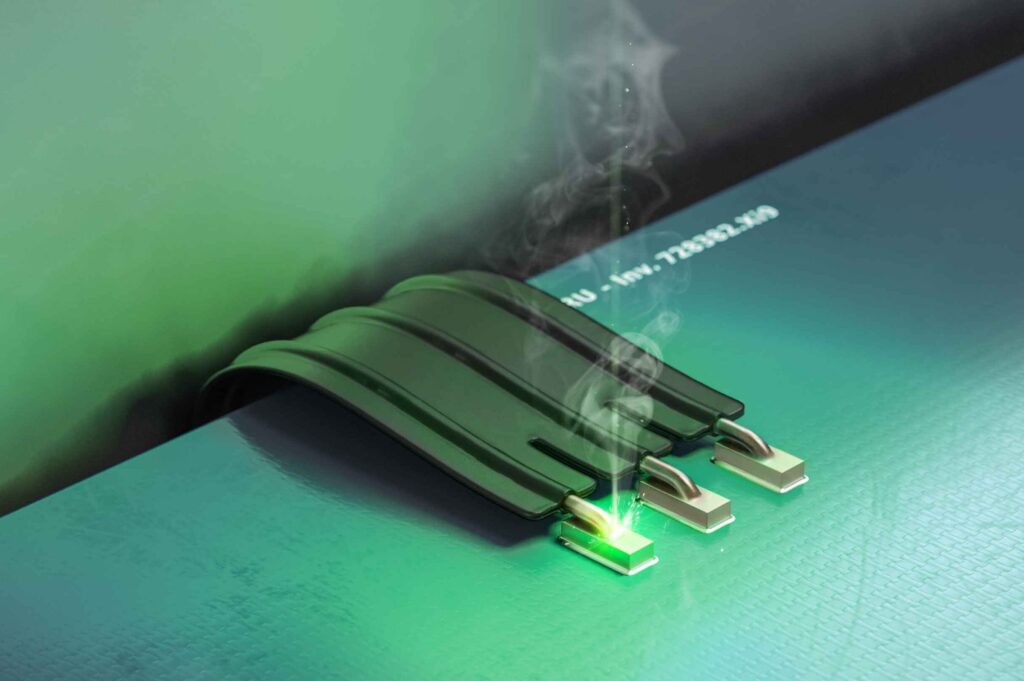
Laser welding is an important part of laser materials processing. The conduction-mode process discussed here is used for thin-walled materials and lower-speed precision joints: radiation heats the surface, and conduction carries that heat into the workpiece. Pulse width, energy, peak power and repetition frequency are controlled to form the required melt pool. These characteristics have supported its use in micro- and miniature-component assembly.
Compared with established joining processes, the application overview identifies the following potential advantages.
High processing speed, useful penetration and limited distortion.
Welding at room temperature or under selected environmental conditions. The optical beam is not deflected by an electromagnetic field, and suitable systems can operate in vacuum, air or a chosen gas atmosphere. Processing can also take place through glass or another material transparent to the beam.
Joining of high-melting-point materials, with titanium and quartz cited as examples, and selected dissimilar-material combinations.
High power density after focusing. In the higher-power applications described, depth-to-width ratios of 5:1, and in some cases up to 10:1, are reported.
Micro-welding capability. A focused, accurately positioned small spot can join miniature workpieces in automated volume production.
Smooth, visually clean seams that can reduce or simplify post-weld finishing.
Under suitable conditions, low-porosity welds and refined joint microstructures, with joint strength and toughness comparable to or greater than the parent metal.
Access to difficult-to-reach areas through flexible, non-contact remote processing. Fiber delivery has extended the application of YAG laser processing systems.
Division of the beam in time and space, supporting multiple beams and workstations for precision joining.
In a fiber-delivered welding machine, the high-energy beam is coupled into an optical fiber, transmitted, collimated and refocused onto the workpiece. Flexible delivery improves access to difficult locations. Time and energy division can support simultaneous processing. The equipment is described as offering good beam quality, small spots and flexible installation, with applications in optical communications components, IT, medical and electronic devices, batteries, fiber-coupling components, cathode-ray-tube electron guns, metal parts, mobile-phone vibration motors, watch components and automotive steel parts.