Biomedical manufacturing requires high cleanliness and consistent quality. Laser welding is increasingly used because it is non-contact, controllable and suitable for automation. Many medical instruments use stainless steel or aluminium, but laser joining also applies to plastic biomedical products. This article describes Raycus 2 μm fiber-laser applications in welding plastic medical-device materials.
Raycus 2 μm thulium-doped fiber lasers
The laser uses fiber Bragg gratings for wavelength selection and locking and bidirectional pumping to support power and beam quality. The described lineup operates at 1940 ±5 nm: CW 100 W with air cooling, CW 200 W or 250 W with water cooling, and QCW 80/800 with air cooling. Delivery options include SMA905, QBH or collimated output, with a 25 μm fiber core and a stated beam-divergence half-angle no greater than 0.09 rad. Delivery-fiber length is customisable, and control uses RS-232/AD interfaces. The compact design is described as offering stable operation, straightforward control, efficient electrical-to-optical conversion and reliability. Applications include plastic cutting and marking, transparent-plastic welding, non-metal processing, pumping of solid-state infrared lasers and medical uses.
The published performance illustration states power stability of ≤±1.5%, power-step accuracy of 2.5%, a stable output spot and no mode hopping.
Plastic-welding applications
Plastics are widely used in medical devices. As manufacturing requirements evolve, laser welding supports applications including Phonak wax guards, biomedical analysis equipment, balloon catheters and diagnostic reagent-kit covers. High local energy density heats the material quickly, with control over the position and size of the heated region. The intended benefits are clean seams, limited particulate contamination and flexible process control.
Compared with near-infrared fiber-laser wavelengths, many polymers absorb more strongly near 2 μm. The described source is used with transparent PMMA, PA, PP and PC biomedical materials, aiming to preserve material properties and produce strong, clean-looking, leak-tight joints.
Reagent-bag material welding
A reported contour-welding example uses a 200 W, 2 μm thulium fiber laser with operating power of 10–100 W, travel speed of 30–200 mm/s and pressure of 0.3–0.6 MPa. The reported results are a flat appearance without discolouration, strong bonding and good sealing.
Biomedical cell-counting chambers
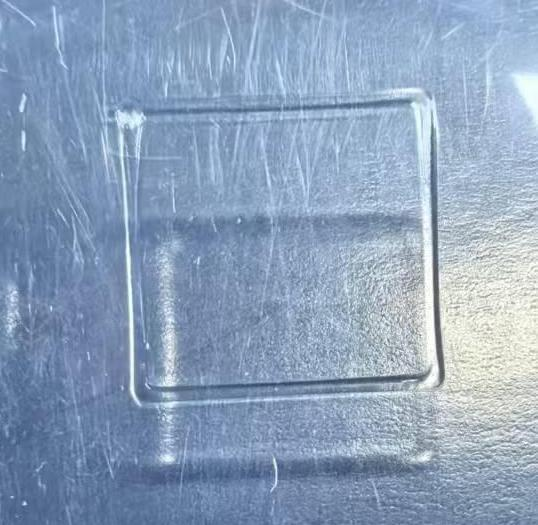
A cell-counting chamber is a precision consumable used with a cell counter to quantify cells in blood, suspensions or other liquid samples. Liquid introduced at the edge enters the chamber beneath the cover through capillary action; the sample is allowed to distribute and settle before microscopic counting. The PMMA chamber in this application has demanding joining requirements, including a stated 1 μm precision requirement, an even seam, no distortion and leak tightness.
In the described Raycus contour-welding trial, laser power was 50 W, speed 40 mm/s, pressure 0.3 MPa and processing time 12 seconds. The reported weld was even and free of bubbles, discolouration and local blowouts, with strong bonding and sealing, meeting the customer’s requirements.
Conclusion
The reagent-bag and counting-chamber examples illustrate 2 μm laser joining of biomedical plastics. Stronger polymer absorption in this wavelength region supports joints with a clean appearance, mechanical strength and sealing performance. Raycus intends to continue developing application processes for biomedical manufacturing through its laser-source technology.