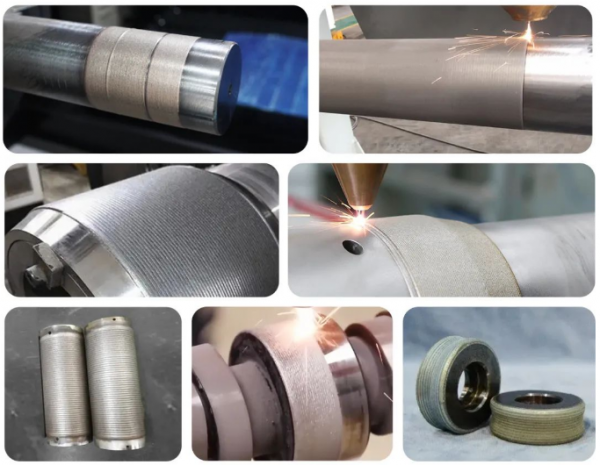
As laser technology develops, Han’s Photonics has used its experience in high-power sources and additive cladding to introduce dedicated lasers and application solutions for manufacturing.
Laser cladding technology
Laser cladding is a form of additive manufacturing in which a high-energy beam heats self-fluxing alloy, ceramic or composite powders on a metal surface. The melt pool cools rapidly to form a metallurgically bonded layer with controlled thickness and a dense, relatively uniform structure.
Self-fluxing powders include iron-, nickel- and cobalt-based alloys. Silicon, boron and other constituents provide deoxidising and fluxing action and support process formation.
Ceramic powders include carbides, nitrides, oxides and silicides. Their wear, corrosion, temperature and oxidation resistance make them useful in protective and thermal-barrier coatings.
Composite powders combine metal and ceramic constituents to bring together properties from both material classes.
After absorbing laser energy, the cladding material heats and melts. Heat transfer to the surroundings and substrate then drives rapid solidification. Subsequent solid-state transformations help determine the final microstructure. Rapid melting and cooling can produce substantial undercooling and non-equilibrium structures, including fine grains, metastable phases and amorphous alloys, supporting improved structural properties.
The technology is presented as a route towards more efficient, resource-conscious and automated manufacturing.
A broad range of industrial applications
China’s 14th Five-Year Plan for green industrial development calls for lower-carbon technologies and support systems. Laser cladding aims to address limitations of established processes with more effective and economically competitive surface-engineering and repair solutions.
Domestic laser-source development and lower source prices, together with more demanding environmental requirements, have expanded the economic appeal of cladding equipment. Applications include aerospace, metallurgy, construction machinery, automotive manufacturing, shipbuilding and additive manufacturing, with examples such as titanium aeroengine-blade and marine-propeller repair.
Dedicated cladding products
Han’s Photonics combines high-performance sources with dedicated cladding heads and other optics. The company describes the solution as suitable for a broad range of specialist repair applications and reports installation at several leading Chinese manufacturers.
The dedicated sources are described as compact, efficient and straightforward to maintain. Beam homogenisation supports a more even energy distribution and smoother clad surfaces; an integrated design provides resistance to back-reflections; and stable output supports process consistency. The published range covers 6,000–20,000 W, with custom output-fiber core diameters of 200–800 μm.
Product features
Stated power instability of ≤±1% over eight hours.
Electrical-to-optical conversion efficiency up to 45%.
A uniform, flat-top beam distribution to support the cladding result.
Optional waveform editing and fieldbus control for different composite-material applications.
Uniform flat-top beam distribution
Shaping the output energy distribution can bring the centre and edge closer to the same intensity, allowing the processing threshold to be reached more uniformly across the spot and supporting consistent surface quality over a wider single-pass area.
Beam shaping for cladding quality
Adjusting beam quality and shaping the spot’s energy distribution can improve centre-to-edge uniformity and the consistency of threshold exposure, supporting a broader processing area and a more even surface.
Optional waveform editing and fieldbus control
Waveform editing allows energy delivery to be adapted for different composite materials. The company describes this as a way to improve processing at the appropriate energy density and reduce vapour-plume effects.
Fieldbus control supports more complex composite-material cladding operations, digital integration and more automated industrial deployment.
Future development
The discussion places China at more than 30% of the global laser-manufacturing market and describes growing use of laser processes. It anticipates that cladding may become a more widely established application, comparable in reach to laser welding.
Han’s Photonics intends to continue internal development and application research, offering stable, efficient and controllable fiber-laser products to improve customer experience and production performance.
The company plans further work in intelligent laser manufacturing and the development of practical high-power fiber-laser products, expanding opportunities for cooperation with customers worldwide.