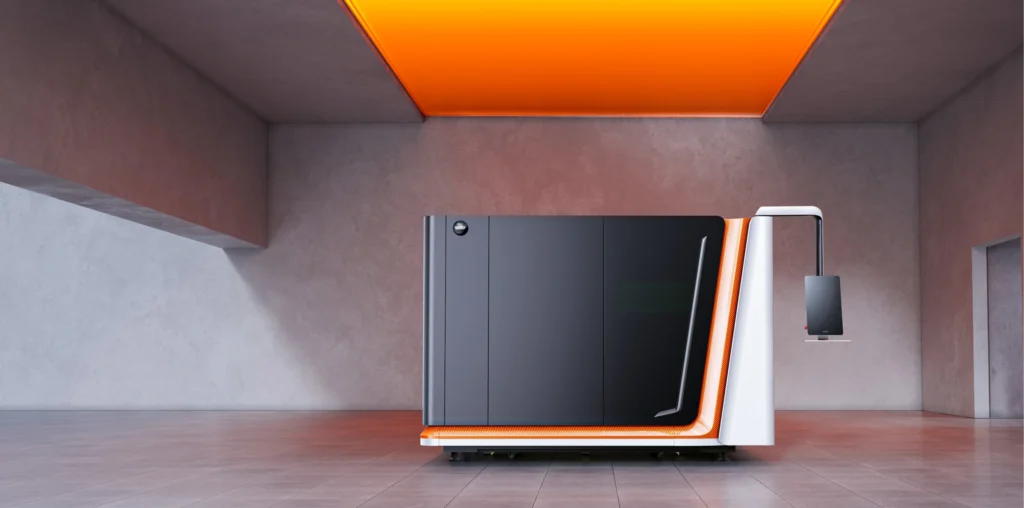
Bodor, a laser-cutting equipment manufacturer based in Jinan, describes a business that has led global unit-sales rankings for several years, develops and manufactures its core components in-house, holds hundreds of authorised patents and operates subsidiaries in more than 20 countries and regions. It is among the Chinese laser-equipment companies that began developing overseas operations relatively early.
Li Dong, assistant to Bodor’s general manager and director of public relations, and Liu Shuangyang, general manager for the Asia–Africa region at its overseas marketing centre, recently discussed the company’s development in a studio interview, explaining how it approaches international competition in laser manufacturing.
Three core components developed in-house; one machine completed every seven minutes
Bodor regards technical development as a central driver of its business. It reports cumulative research and development investment of more than CNY 100 million and a research team of several hundred people working on critical industry technologies.
“In core technology, we have consistently pursued our own brand and independent development, keeping core technologies and processes in China. We now develop and manufacture the laser head, laser source and operating system ourselves,” Liu said. He added that the company holds hundreds of core intellectual-property rights, enabling it to control product performance and quality from the component level.
In manufacturing, the company says it combines a focus on higher-end equipment, detailed operational management and regulatory compliance. It describes adherence to international safety and compliance requirements, standardised production processes, fully automated production lines, process-wide manufacturing controls and detailed product adjustment to support equipment stability and performance.
Bodor reports that the digital manufacturing system at its Dream Space factory supports large-scale, standardised production, with an average of one machine completed every seven minutes and annual production capacity of 20,000 machines.
Liu described independent development and standardised control throughout production as the basis for Bodor’s participation in global competition. “They underpin our position in the laser industry and our ability to support manufacturing customers around the world and earn market recognition,” he said.
Li said that the company had recently released its White Paper on the Classification of AI Cutting Machines and its flagship Z-series tube laser-cutting machine. He described incorporating AI-based perception, diagnosis and decision-making into equipment, combining AI with laser cutting and moving competition beyond hardware specifications towards coordinated intelligent systems.
The company says its sheet, tube and high-power intelligent-equipment portfolio addresses different regional and customer requirements in construction machinery, new energy, automotive manufacturing and steel structures. It also reports receiving international industrial-design awards including Red Dot: Best of the Best and iF awards.
Developing an international business under its own brand
The interview described the Olympic rings and internal frames used on podiums at the Tokyo Olympic and Paralympic Games as having been cut using laser-cutting equipment manufactured by Bodor in Jinan.
According to figures released by the Qianzhan Industry Research Institute in March 2026 and cited in the interview, Bodor ranked first worldwide in unit sales of laser-cutting machines rated at 1,000 W and above for seven consecutive years.
“Long-term development requires participation in global competition and expansion into global markets,” Liu said. Since its establishment in 2008, the company has focused on laser cutting and on building an international Chinese brand. He said that improving quality, reducing costs and increasing efficiency were shared manufacturing needs worldwide. China’s manufacturing supply chains, supporting infrastructure and the company’s accumulated research experience gave it a basis for competitive equipment and solutions. He also described an overseas market historically led by established manufacturers, with some customers seeking more affordable and stable equipment. These conditions led the company to pursue international growth under its own brand.
Liu said international expansion involved more than exporting machines. The company targets requirements in local high-end manufacturing markets, divides markets into specific regions and adapts its equipment and development approach to local industries. Metal processing and steel structures are among the areas in which it provides integrated solutions.
Li described local service as a differentiator. “We establish subsidiaries in major markets and provide round-the-clock technical support and on-site service. We have local spare-parts warehouses and professional engineers in Germany, the United States, Brazil and other locations. This shortens delivery cycles and extends equipment supply into support throughout its lifecycle,” he said.
At the time of the interview, Bodor reported subsidiaries in more than 20 countries and regions, including the United States, Germany, Japan and Brazil, and equipment supplied to more than 200 countries and regions. It also reported over 200 service outlets, with technical and after-sales engineering teams, continuous response arrangements, locally stocked parts and remote support covering installation, commissioning, process training and repairs.
Shandong’s manufacturing and international-trade infrastructure
As a manufacturer originating in Shandong, Bodor regards the province’s industrial base and policy environment as important support for international expansion. Li said its manufacturing infrastructure, export-support system and continuing industrial-policy improvements provided a foundation for the company’s global development.
Shandong has established supply chains in equipment manufacturing, metal materials and precision processing, including steel, precision castings and machinery components. Li said the cluster of laser suppliers around Jinan’s Qilu Optics Valley helped improve product quality and delivery efficiency. Construction machinery, new-energy and steel-structure companies in the province also provide application environments for new technologies and equipment.
The interview noted Shandong’s efforts to develop local multinational companies and its integrated international-business service platform. It also described policies supporting innovation, placing high-end equipment and lasers among priority industrial chains, encouraging leading companies to develop core technologies and international standards, and supporting their expansion into global markets.
Looking ahead, Li said Bodor intended to use its role in Shandong’s laser supply chain to help upstream and downstream small and medium-sized companies participate in international markets and develop an internationally connected laser-manufacturing ecosystem.