More frequent natural disasters and unusual climate conditions have increased attention to environmental issues. As economies pursue carbon neutrality, manufacturers are reducing energy use and changing production methods to support sustainable development. Laser processing can contribute to that transition.
Shanghai Jiaocheng Building Mould Co., Ltd., established in 2013, designs and manufactures moulds for prefabricated building components. The case describes it as China’s first company to specialise in mould production for prefabricated building components, with recognition from industry peers and customers. It began introducing laser-cutting equipment in 2014 to support production.
Compared with traditional frame construction and on-site casting, prefabrication can offer consistent quality, shorter schedules, easier assembly and lower resource use. It transfers part of construction activity from building sites to standardised factory production. With labour becoming more expensive as the working population declines, building companies are increasingly interested in methods that can improve housing quality while reducing labour requirements.
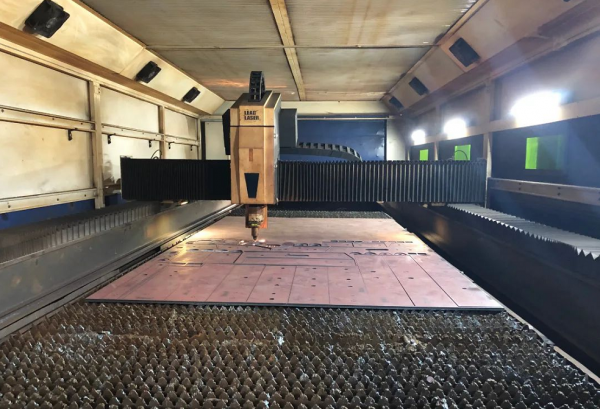
Steel plate and steel sections are major materials for prefabricated-building components, making laser processing relevant. Quality requirements are particularly demanding in construction. In 2014, Deng Bin, Jiaocheng’s deputy general manager, and his team selected a 2,400 W machine from Lingchuang, also known as Lead Laser. At the time of the case, the machine remained in service, with accuracy and stability meeting the company’s expectations and relatively little maintenance beyond ordinary mechanical wear. Jiaocheng subsequently purchased three more machines from the supplier.
The case describes Lingchuang’s continued investment in research, system improvements and cost reduction, aimed at improving technology while keeping equipment affordable. Jiaocheng regarded those efforts as evidence of the supplier’s commitment.
To meet order requirements, Jiaocheng later upgraded the original 2,400 W equipment. The case reports that its two Shanghai machines and two at its Guangdong subsidiary had all become 6,000 W systems, with a noticeable increase in production capacity after the upgrade.
Discussing operation, Deng compared two 6,000 W machines in Shanghai, one using a Chinese cutting head and the other an overseas brand. He said metal dust could enter the domestic head’s drive mechanism after extended use and damage lenses, while the imported head could overheat and also require lens replacement after more than a year. Considering maintenance costs, he regarded domestic equipment as close in performance while reducing expenditure. He also highlighted stability and customisation. For two adjacent machines, a mirrored arrangement of auxiliary equipment made better use of factory space. The supplier subsequently adapted the equipment so that auxiliary units could connect on either side of the main machine.
The case concludes that equipment users value stable quality together with supplier innovation and service. Jiaocheng’s laser-processing operation had become a point of exchange with other manufacturers. Lingchuang said it intended to continue developing equipment for a wider range of users.