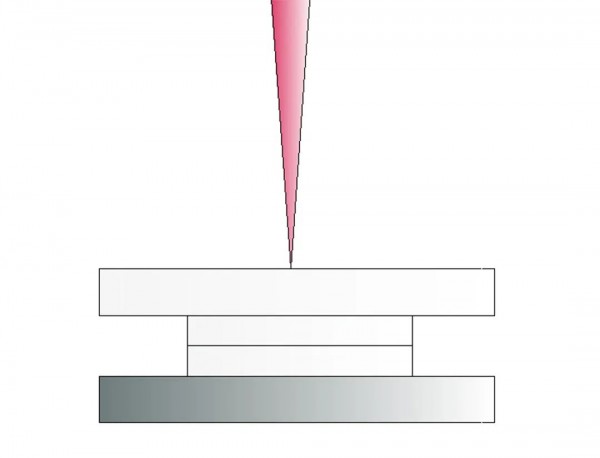
How transparent-plastic welding works
The process uses the infrared absorption of the selected transparent plastic. Controlled laser energy heats the contact surfaces of two layers until they begin to melt; pressure then brings them together to form the joint.
Process approach
Transparent plastics are often used in medical products to avoid the effects of additives. Common transparent polymers absorb relatively little light from diode lasers in the 915–980 nm range. Welding at those wavelengths can therefore require an absorbing material between the layers, adding cost and raising questions about biological compatibility.
A longer infrared wavelength with greater absorption in the selected polymer, together with a suitable fixture, allows transparent plastic to be joined directly to transparent plastic.
Common joint configurations
An inner-and-outer sleeve arrangement.
An overlapping upper-and-lower layer arrangement.
In a common lap joint, the upper transparent layer absorbs the laser energy; the application description recommends an upper-layer thickness no greater than 1.0 mm to limit surface effects. For concentric sleeves, an interference fit provides contact and a degree of clamping force.
Joint appearance
Compared with ultrasonic and vibration welding, the described laser process produces lower mechanical stress, avoids direct tool contact with the visible surface and welding debris, and can reduce tooling costs.
Production efficiency
Compared with hot-plate and hot-gas methods, potential benefits include lower thermal stress, less flash and spatter, shorter cycles and lower equipment and tooling costs.
Process stability
Compared with joining processes using additional hot-melt or adhesive materials, the process can avoid extra joining material, simplify control and provide stable joint quality and shorter production cycles.
Applications
Transparent-plastic laser welding is used in medical product assembly and packaging, including transparent tubing, diagnostic test housings, microfluidic components, medical filters and pump bodies.