Introduction
As the global automotive industry moves towards electrification, traction batteries have become a central determinant of new-energy vehicles’ performance, safety and cost. Battery manufacturing combines materials science, electrochemistry and precision mechanics, with high-quality joining required throughout. Resistance welding, ultrasonic welding and other established methods face limitations in high-volume automated production and when joining thermally conductive copper and aluminium, including heat effects, consistency and narrow process windows. Laser welding combines high energy density, controllable heat input, non-contact operation and suitability for automation. These characteristics support the precision, throughput and reliability required from cell manufacture through battery-pack assembly. This overview examines the process at different manufacturing stages and its contribution to battery production.
Applications in cell manufacturing
Cells are the basic units of a traction battery, and manufacturing accuracy and sealing are fundamental to their performance and safety. Laser welding is used for precision connections and final sealing. Within a cell, it joins electrode tabs: after winding or stacking, tens or even hundreds of layers of positive-electrode aluminium foil and negative-electrode copper foil must be joined and connected reliably to external terminals or transition pieces. Short laser pulses can fuse these thin layers into low-resistance, mechanically strong connections. A small heat-affected zone helps protect nearby separators and active materials and preserve electrochemical performance.
Laser welding also provides a method of hermetic sealing during final cell packaging. In prismatic aluminium and cylindrical steel cells, it joins the lid to the housing. Control of laser power, travel speed and focus position produces a continuous, smooth, dense seam intended to prevent electrolyte leakage and moisture ingress and maintain the cell’s internal chemical environment throughout service. In pouch-cell packaging, laser welding joins the emerging tabs to connecting and protective transition pieces, typically nickel-plated copper or aluminium. Its non-contact operation supports efficient joining while limiting damage to the aluminium–polymer packaging film.
Applications in module and battery-pack assembly
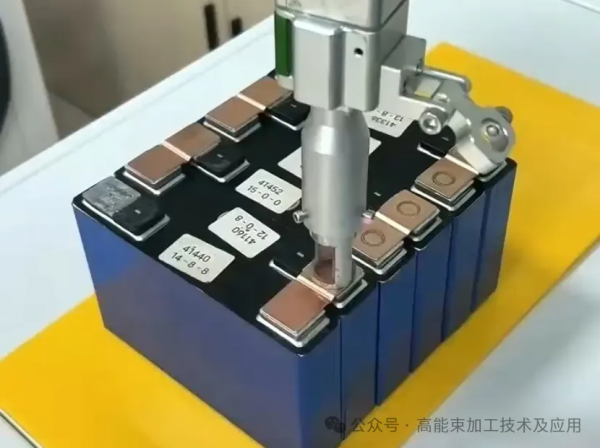
Combining individual cells into modules and packs requires many electrical connections and structural joints, making this a major and technically demanding area for laser welding. The central electrical application is the series and parallel connection of cells. Aluminium or copper busbars are joined to cell terminals to form the pack’s electrical network.
Two principal difficulties are material behaviour and dissimilar-metal joining. Copper and aluminium reflect commonly used infrared laser light and conduct heat rapidly. Joining a copper busbar to an aluminium terminal can also form brittle intermetallic compounds (IMCs), affecting long-term reliability. Industry responses include wobble laser welding, hybrid processes such as laser–arc welding, and green or blue laser wavelengths. By expanding and stirring the melt pool or improving absorption, these approaches can reduce spatter and porosity and control IMC-layer thickness. Laser welding also joins module side and end plates and battery-box housings and covers. Compared with bolted or riveted assemblies, it can support greater integration and structural strength, contributing to vibration and impact resistance. Small connections in battery-management voltage- and temperature-sensing circuits are also increasingly laser welded to support stable, reliable signal acquisition.
Conclusion
Laser welding contributes precision, speed and reliability across traction-battery production, from microscopic tab joints to pack structures, hermetic seals and low-resistance electrical connections. It helps address difficult-to-weld copper and aluminium, supports the throughput and consistency of automated manufacturing and limits heat transfer into electrochemically active parts. Continued development of the process supports higher energy density, lower manufacturing costs and improved battery safety, providing a manufacturing foundation for the expansion of electric vehicles.